The Screech, the Clunk and the Click: Eight Sounds That Still Live in British Gamers' Heads
There's a particular cruelty to game nostalgia. You can't taste a loading screen. You can't smell a memory card. But sound? Sound gets in through the wall. Half a bar of a startup jingle, one mechanical clunk from the hallway, and you're ten years old again, sitting far too close to a portable telly your nan lent you because the good one was being watched.
So here's a list. Not the definitive one — the definitive list would run to four hours and would end with someone's dad shouting up the stairs that it's gone eleven — but a starting point. Eight noises that did more for British gaming culture than any graphics card ever managed.
1. The tape screech
If you grew up with a Spectrum, a Commodore or an Amstrad, you grew up with that sound. The high, wobbling carrier tone, the chirrup and hiss of data being shouted down a length of cheap audio cable, and then — if the gaming gods were kind — the sudden silence before a game appeared. If they weren't, you got the message that still lives rent-free in a generation's head: R Tape loading error.
Nobody had a memory card. Everybody had a C90 with a biro label on it. The sound of a tape loading was the sound of hoping.
2. The Ceefax bleep
Before the internet there was Teletext, and before forums there was Digitiser, and before most of us could read a review without getting told off, there was Bamboozle. Those page transitions — that terse little electronic beep as the numbers ticked up to 380 — were the soundtrack to secrets being told.
It's worth remembering that a lot of British players got their first games writing, their first release dates and their first sense of a wider gaming world from a blocky page on a CRT. Teletext wasn't a nostalgia curio. For a while it was the whole culture, delivered at four lines a second.
3. The dial-up handshake
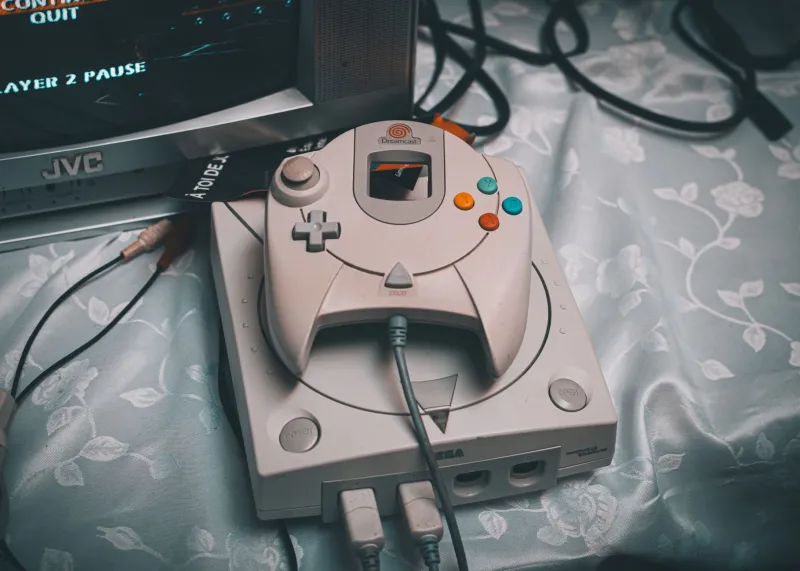
The modem's little negotiation — the dial tone, the whistles, the static that sounded like a robot being sick in a bin — was the gate into online gaming for a lot of us. Dreamcasts, early PCs, a shared phone line and a parent who would absolutely pick up the receiver mid-match.
You didn't just connect to a server. You committed to it. Which is why that sound still means something: it's the noise of going somewhere you weren't supposed to be, slowly.
4. The PlayStation startup
That wobbly, reverb-soaked swell. You know exactly the one. It's the sound of a console that felt like it belonged in a living room rather than a bedroom, and it arrived with a demo disc, a wallet-clearing price tag and a certain seriousness about itself.
For a lot of British players it's the exact point where games stopped being something you did in your room and started being something you did with mates, on a sofa, in a house where somebody's mum had made tea.
5. The scart click
The resistance, then the click, then the darkness. Then the fumbling for the remote to find the right channel, then the degauss bong of a CRT deciding to behave.
This is the least romantic sound on the list and possibly the most British. It's the sound of the whole household agreeing to something. Scart leads were physical, fiddly, and if you got the order of the AV channels wrong you were staring at a blue screen for twenty minutes while someone said "have you tried it in the other one".
6. The Wii Remote strap warning
Two rapid notes and a graphic of a strap being tightened. We all laughed. We all ignored it. And then somebody's overenthusiastic backhand sent a controller into the front room telly, and the warning stopped being funny and started being a police report.
That little chime is interesting, actually. It's a safety announcement disguised as a game sound, and it arrived in a console that got grandparents, cousins, flatmates and people who'd never touched a pad all playing together. The noise is funny because the memory is communal.
7. The clunk of a controller on carpet
No game makes this sound. Every game has this sound. It's the soft, slightly sad thump of a pad being dropped on a rug at the end of a long session, or the sharper clatter of one being thrown after a 96th-minute defeat.
Bonus entry: the rattle of an N64 rumble pak, or the whirr of a disc tray ejecting at 2am on a school night. Devices used to be noisy. You could hear the machine working.
8. The "one more go" silence
Not a sound, this one, but the absence of one. The pause after a hard boss, when the room goes quiet and everyone breathes out. Then someone says "go on then, one more".
It's the same quiet that fills a pub when a penalty's about to be taken, and it might be the most underrated piece of multiplayer design in history.
Why any of this matters
It would be easy to file all this under remember-when and leave it there. But sound is the fastest route to memory we've got, and it's also the most social. Nobody gathers round to look at a screenshot of a loading screen. People absolutely gather round to do the modem noise at each other.
There's a craft argument in here too. We spend a lot of time these days talking about performance modes and resolution, and comparatively little on audio design — which is, for most players, the difference between a game that feels solid and a game that feels real. The sounds in this list are mostly accidents, mechanical by-products and compressed jingles. They've outlived entire franchises.
So: which one gets you? For me it's the tape screech, every time — the sound of being nine, on a Saturday, with nothing to do and everything to look forward to.
Answers in the comments, please. Extra credit if you can do the dial-up noise from memory.