The Back-Garden Coin-Op: Why Britain's Home Arcades Are Having a Moment
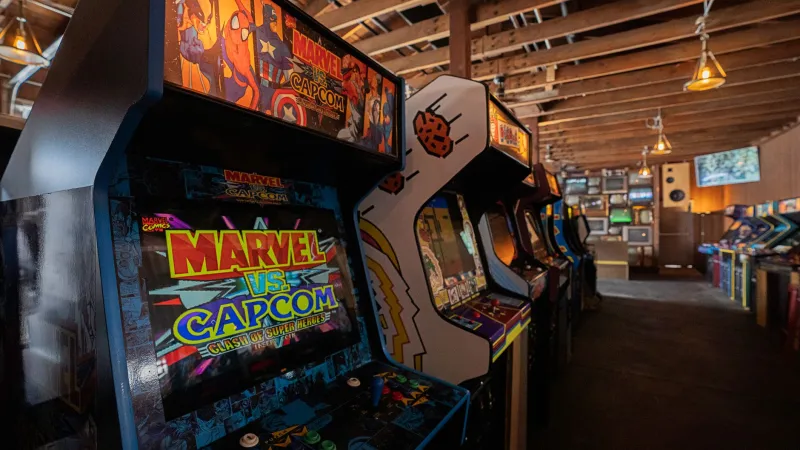
There is a particular sound that gives away a British home arcade long before you see it. Not the boot chime of a console, or the soft click of a mechanical keyboard, but the hollow thunk of a coin mech being tested, followed by the muffled swear of someone who has just realised the cabinet will not fit through the shed door. It is a sound drifting across gardens from Leeds to Llanelli in 2026, as more players decide that the best place for a arcade machine is not a seaside pier or a retro bar, but the bit of the house where the lawnmower used to live.
The shed is the new high street
Britain's relationship with the arcade has always been a bit romantic and a bit impractical. We love the idea of a room full of glowing cabinets, but we also love a spare room that stores Christmas decorations and a garage that has never once housed a car. That tension is exactly what makes the home arcade scene so interesting right now. Builders are not waiting for a perfect venue. They are measuring doorways, shifting shelving units and convincing partners that a bartop cabinet is, technically, furniture.
Some of these setups are museum-grade restorations of 1980s and 1990s cabinets. Others are custom MAME builds in plywood shells, or compact sit-down units that fit beside a desk. The common thread is not money or technical wizardry. It is the desire to own a machine that does one thing brilliantly: invite you to stand in front of it and have a go.
From dead cabinet to centrepiece
The typical project often starts with something slightly tragic. A cabinet listed on Facebook Marketplace as 'spares or repair', a former operator clearing out a lock-up, or a mate-of-a-mate who knows someone with a Pac-Man-shaped problem in their garage. The first job is rarely electronics. It is inspection, woodwork and a serious conversation about damp.
Restorers talk about t-molding, control panel overlays and monitor mounts the way other hobbyists talk about brake pads. A cabinet might need new feet, a replacement marquee, a good clean of its coin door and a careful check of its wiring before anyone dares switch it on. The golden rule from the community is simple: do not just plug in a mystery cabinet and hope. Check the power supply, look for scorched connectors and ask for help if you are not sure. A home arcade should be a joy, not a fire risk.
MAME, MiSTer and the great CRT debate
For players who cannot find or afford an original cabinet, emulation and FPGA options have opened the door. A modest mini PC or Raspberry Pi can run MAME inside a custom shell, while MiSTer setups offer a more hardware-flavoured route for those who care about latency and authenticity. The result is a spectrum of home arcades, from a single bartop on a desk to a multi-cabinet room with its own breaker switch.
Then there is the screen argument. CRT fans will tell you, at length and with genuine passion, that scanlines, glow and the slightly soft look of an old tube are part of the experience. LCD builders point to practicality, weight and the fact that a modern panel does not need a qualified repairer every time it coughs. The honest answer is that both camps are right. The best screen is the one that makes you want to play.
Spares, swaps and forum goodwill
What makes the UK scene feel genuinely player-first is the parts bin culture. Arcade forums, Discord servers and regional WhatsApp groups are full of people swapping leaf switches, joystick gates, JAMMA looms, power supplies and the odd obscure bracket that has been in a drawer since 1998. A newcomer asking a basic question will usually get a patient answer, a link to a wiring diagram and three different opinions on which microswitch feels best for shoot-'em-ups.
That generosity matters because arcade hardware is not always plug-and-play. Connectors differ, voltages bite back and reproduction parts vary in quality. The community's willingness to share measurements, photos and hard-won mistakes turns a intimidating project into a weekend one. It also keeps old machines alive instead of letting them rot in storage.
The ritual of the physical machine
A home arcade is not really about owning a rare cabinet. It is about the ritual. You stand up. You put your hand on a joystick that has actual resistance. You press a chunky start button. The screen does not ask you to download a launcher or sign into an account. It just says go.
That physicality changes how people play. High score tables become household legends. A two-player cabinet pulls people off the sofa and into the same space, elbows out and egos bruised. Children discover that a coin mech is a brilliant piggy bank with a screen attached. And adults discover that a fifteen-minute blast on a shoot-'em-up is a better reset than another scroll through the phone.
Start small and keep it playable
If you fancy building your own, the advice from seasoned shed arcade owners is refreshingly practical. Measure every doorway twice. Think about power, ventilation and noise. Decide whether you want a restoration, a kit or a scratch build. Start with a bartop if space is tight, and do not let the pursuit of perfect authenticity stop you from actually playing.
Most of all, build something you will switch on. A home arcade does not need to be a showroom. It needs a decent joystick, a screen you like and a spot where a mate can stand next to you and say 'one more go'. In 2026, that is still the best feature any machine can have.