Checked Out, Not Left Out: The UK Libraries Quietly Keeping Games in Players’ Hands
Walk into plenty of UK libraries in 2026 and the first thing you notice is still the books. The second thing might be a stack of Switch cases behind the counter, a controller charging next to the staff PC, or a handwritten sign for a Tuesday after-school Mario Kart club. It is not a flashy revolution. It is infrastructure — quiet, patchy, and often held together by one enthusiastic librarian and a locked cabinet.
That matters because the way British players buy games has changed. Retail shelves have shrunk, pre-owned sections have thinned out, and the gap between “I want to try that” and “I can justify £50” has widened. Libraries have not solved that. But in a growing number of branches, they are doing something practical about it: lending games, lending kit, and giving local players a free place to play with other people.
The shelf behind the counter
The games collection is rarely the first thing you see. In many branches, discs and cartridges live behind the desk, in a cabinet, or on a short run of shelving near the DVDs. That is partly security, partly space, and partly because games need a bit more care than a paperback. Cases get mixed up. Discs get scratched. Controllers go missing. Staff have to decide whether a donation is a welcome addition or a future argument at the counter.
A branch librarian in the North West, who asked not to be named, says the collection started with donated Xbox 360 and Wii titles and a single locked drawer. “We had to learn as we went,” she says. “Which ratings we could put on the open shelf. How to label things so people could actually find them. What to do when someone returns a game with no disc inside.”
The result is not a rival to a specialist shop. It is more like a small, curated shelf with a queue. And the queue is the point.
The reservation queue is the new release day
If you want a popular game from a library, you do not browse and grab. You reserve it. You join a hold list. You wait. In some branches, the wait for a big first-party title can run for weeks. In others, the collection is built around older games, family favourites and anything that circulates well rather than anything that looks good in a display case.
Players I spoke to described the same rhythm: check the catalogue, place a hold, get the email, pick it up within the window, play it fast, return it. It is closer to renting a game from a video shop than to buying one, except the shop is free and the late fee is usually a stern look and a block on your account.
That changes how you play. You take more chances on a game you would never risk £40 on. You finish things. You try a genre you would otherwise ignore. One player in Sheffield told me she used her library card to work through a run of strategy games she would never have bought, simply because the only cost was the walk into town.
Age ratings, parents and the awkward bits
Games are not books, and libraries know it. PEGI ratings matter. A 12-rated game on a children’s card is one thing; an 18-rated title is another. Many branches restrict higher-rated games to adult cards, or keep them behind the counter entirely. Some will not stock 18-rated games at all, because the paperwork and the conversations are not worth the hassle.
That can be frustrating for older teenagers who are used to buying games themselves. But it also makes the library one of the few places where a parent can ask a straightforward question and get a straightforward answer. Staff are used to it: what is this game actually like, is it suitable for a nine-year-old, does it have online chat, why is the cover so grim.
The awkward bits are practical. Damaged discs are a constant headache. Some libraries charge replacement fees; others simply stop lending certain titles. Controllers are riskier still, because drift, sticky buttons and missing battery covers are hard to police. Several branches now lend controllers only for use in the building, not for taking home. It is less exciting, but it keeps the kit alive.
The after-school club is the real draw
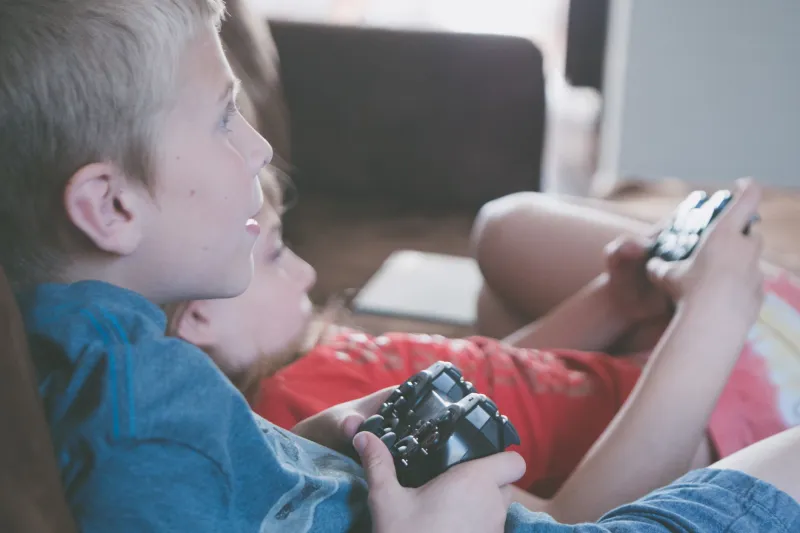
Ask librarians what actually brings people in and the answer is rarely the shelves. It is the club. A weekly after-school session with a couple of consoles, a projector and a stack of multiplayer games can turn a quiet corner into the busiest part of the building. Mario Kart, Rocket League, EA Sports FC, Minecraft, Smash Bros — the games are familiar, the setup is simple, and the social side does most of the work.
These clubs are not esports. They are not childcare. They are closer to a youth club with a screen, and the best ones are run with clear rules: take turns, no rankism, no gatekeeping, ask before you plug anything in. One librarian in Leeds describes the club as “the only time the building is loud in a good way.”
For players who do not have a big TV, a spare controller or a friend nearby, that hour matters. It is also a low-pressure way for parents to see what their kids are playing without buying anything.
Can the library become a third space for gaming?
The honest answer is: sometimes. A library is not a dedicated gaming café. It has opening hours, staff limits, noise rules and a broad public remit. Games have to share space with reading groups, job clubs and quiet study. But that is exactly why the library works as a third space — it is free, local, and does not expect you to buy a coffee to stay.
The branches getting it right tend to do the same things. They start small. They build a collection around what people actually borrow. They train staff on ratings and basic troubleshooting. They protect the good kit. They ask players what they want instead of guessing. And they treat games as part of the collection, not a gimmick.
If you want to use your library for games, start with the catalogue rather than the shelf. Ask about reservations, inter-library loans and donation policies. Suggest titles. Volunteer for a club if one exists. The library card level-up is not a marketing campaign. It is a quiet, practical way to keep games in players’ hands as the high street changes.
And if your local branch has a locked cabinet with three Wii games and a drifting controller inside, do not dismiss it. That is how these things start.